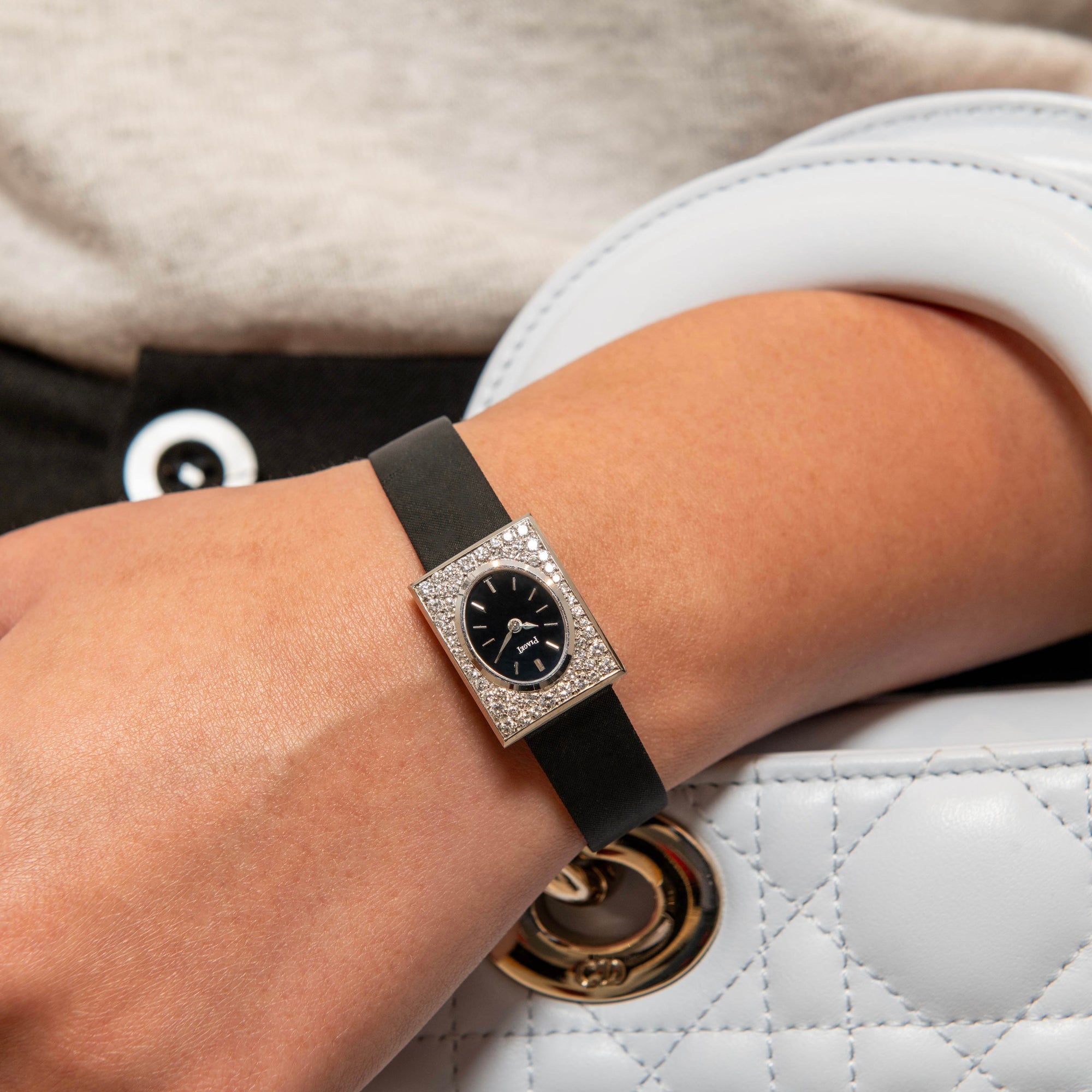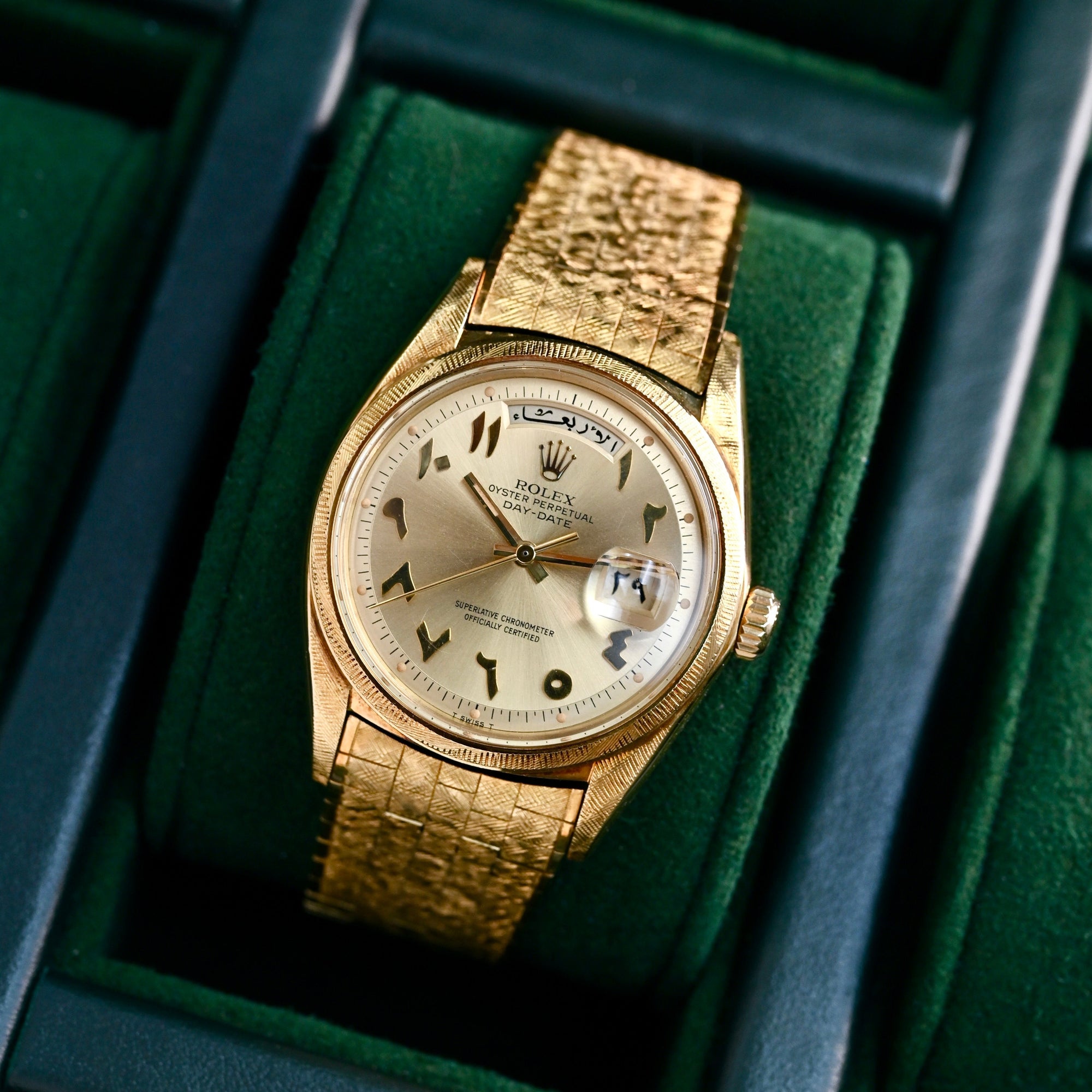
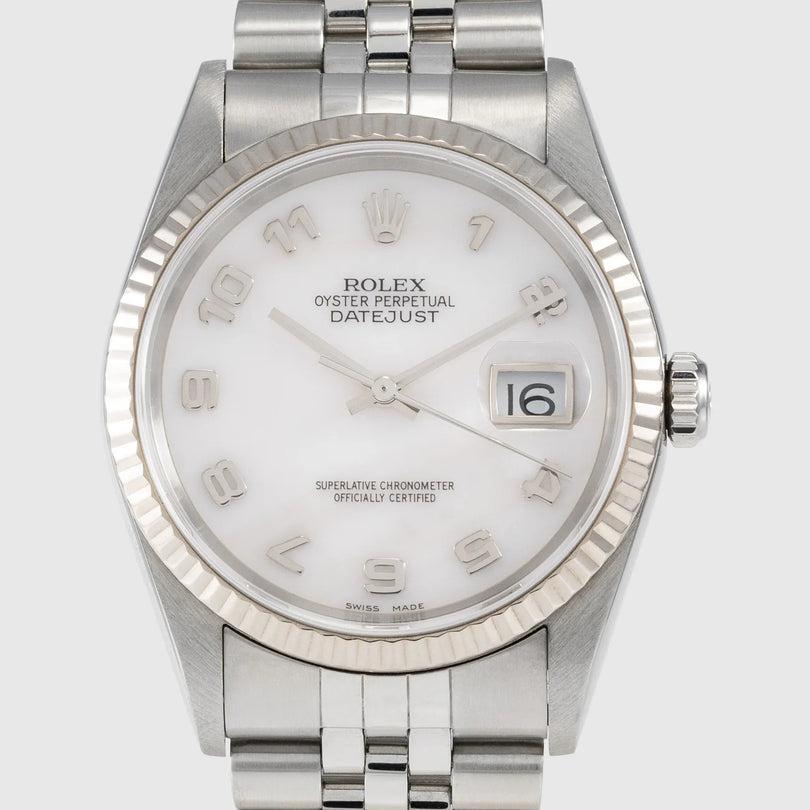
Rolex hasn't left a stone unturned when it comes to the selection of materials of their dials. Stone, enamel, lacquer, diamonds — each represents a different chapter in the brand’s pursuit of texture and tone. And yet, among all these, wood might be the most unexpected.
 Yes, Rolex once made wooden dials. They appeared briefly in the 1970s and remain among the most elusive variations in the Day-Date family. Most collectors know the glossy birch, walnut, and burl versions seen on sapphire-crystal references from the later decade. But there was one that came before — more rugged, more organic, and far rarer: Sequoia.
The watch
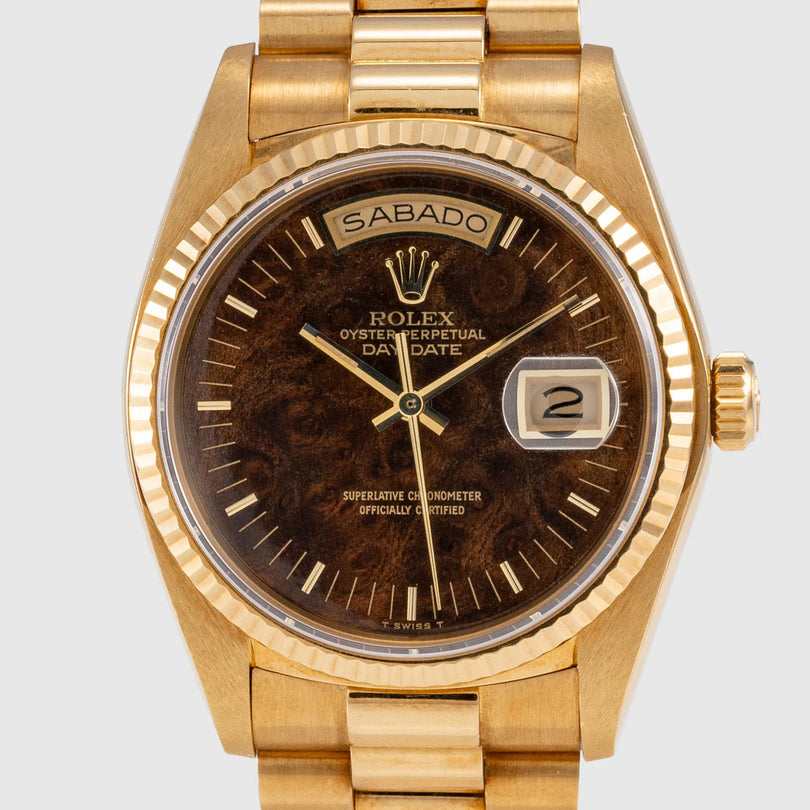
The 1803 is the archetype of the vintage Day-Date: 36 mm of 18-karat yellow gold, fluted bezel, acrylic crystal, and the calibre 1556 automatic movement beating beneath a solid screw-down back. This example remains in beautiful vintage condition — strong case proportions, clean lug lines, and a bezel that still catches light with that unmistakable crispness of early production.
 The President bracelet with its long clasp is equally well preserved, showing moderate, even wear consistent with its age. The overall impression is of a watch that has been worn respectfully and maintained with care, retaining its character without the over-restoration that erases history.
The Sequoia dial
The first thing that strikes you is texture. Unlike later wood dials, which Rolex coated in glossy lacquer to achieve a smooth, almost mirror-like finish, the Sequoia surface feels raw and natural. It’s matte, uneven, and alive with grain. You can see the fine veins of the wood, the subtle tonal shifts from chestnut brown to deep amber.
 Each Sequoia dial is completely unique. The pattern depends entirely on the slice of wood chosen — no two ever look alike. Some show bold streaks, others fine whorls. In this example, the tone is a warm, matte brown that harmonises beautifully with the gilt print and gold hour markers and it was ever only made for yellow gold watches. Under certain light, the dial almost glows, its fibres catching the light like threads of silk hidden beneath the grain.
 The printing on these early Sequoia dials was applied directly onto the porous surface, before Rolex had perfected the lacquering process used in later wood models. As a result, the text sometimes softens slightly into the grain, giving the dial a depth and warmth that no smooth lacquer could replicate. It’s an effect that can only happen once — it’s impossible to reproduce.
This example’s text remains crisp and clear, the gold indexes perfectly set, and the tritium lume dots original and beautifully aged.
Early experiments in natural material
The Sequoia dial was one of Rolex’s first attempts to integrate natural material into its production dials, predating the better-known stone series. These watches were true experiments — both technically and aesthetically.
 The idea of using wood on a solid gold Day Date might seem surprising, but in the context of the early 1970s it made perfect sense. It was an era when design, architecture, and interiors all embraced organic materials — think walnut dashboards, teak furniture, and the natural textures of Scandinavian minimalism.
Rolex’s approach was consistent with its philosophy: take something natural, master it, and transform it into something enduring. But wood presented challenges stone never did. It expands, contracts, and changes with humidity and temperature. To stabilise it, Rolex had to slice it extremely thin — far thinner than any veneer — and mount it carefully onto a brass plate.
 These early Sequoia dials pre-date the perfected lacquering techniques of later wood models like birch and burl. They were flat, not pie-pan, and carried a more industrial, almost prototype quality. Some see that as imperfection; others — especially collectors — see it as character.
Rarity
If we were to count every Sequoia dial Day-Date ever documented, the number would stay under fifty examples worldwide — across all conditions. That makes it rarer than most stone-dial variations and far less common than any Stella.
 Production seems to have been limited to the early 1970s, exclusively for four-digit references, before Rolex transitioned to sapphire-crystal models. Once the later, lacquered wood dials entered production, the Sequoia vanished quietly from the catalogue.
Its rarity also means that it’s often misunderstood. Many collectors have never seen one in person. When they do, the matte, rough finish can appear unusual next to the glossy birch or burl versions they’re used to — but that is precisely what defines the Sequoia: it’s the origin point of Rolex’s fascination with natural surfaces.
The beauty of imperfection
There’s something profoundly tactile about this dial. It’s not glossy, it doesn’t shimmer like lacquer — it absorbs light. It feels closer to sculpture than to decoration. The tiny variations in colour and grain remind you that this surface once grew in nature.
 This connection to the organic world gives the Sequoia a warmth that’s hard to describe. The straight hour markers and balanced layout ground the dial’s texture, creating harmony between nature and geometry.
Even the way the print interacts with the wood — soft at the edges, deep in tone — feels poetic. It’s the kind of imperfection that tells you a human hand was involved.
Condition
This 1803 remains in excellent, well-preserved condition. The case shows light wear but retains solid proportions and legible numbers between the lugs. The fluted bezel is crisp, and the President bracelet with its long clasp still sits tight and original.
 The dial has aged beautifully, the wood grain mellowing slightly over time but remaining stable — a rare trait for this material. The tritium lume on both dial and hands is consistent, fading evenly under UV exposure as expected. Every element feels authentic, coherent, and in keeping with the watch’s age.
 It’s accompanied by its original certificate, further confirming its authenticity and adding to its already exceptional provenance.
Why we love it
This Sequoia Wood Day-Date 1803 represents one of Rolex’s earliest experiments with unconventional materials — a watch that bridges traditional craftsmanship and modern design. It stands at the beginning of a lineage that would later include the bold colours of Stella lacquer, the richness of stone dials, and even the guilloché experiments of later decades.
 Among collectors, it occupies a special place: incredibly rare, historically significant, and visually arresting in its simplicity. The fact that it still feels modern fifty years later only reinforces how ahead of its time this experiment truly was.